
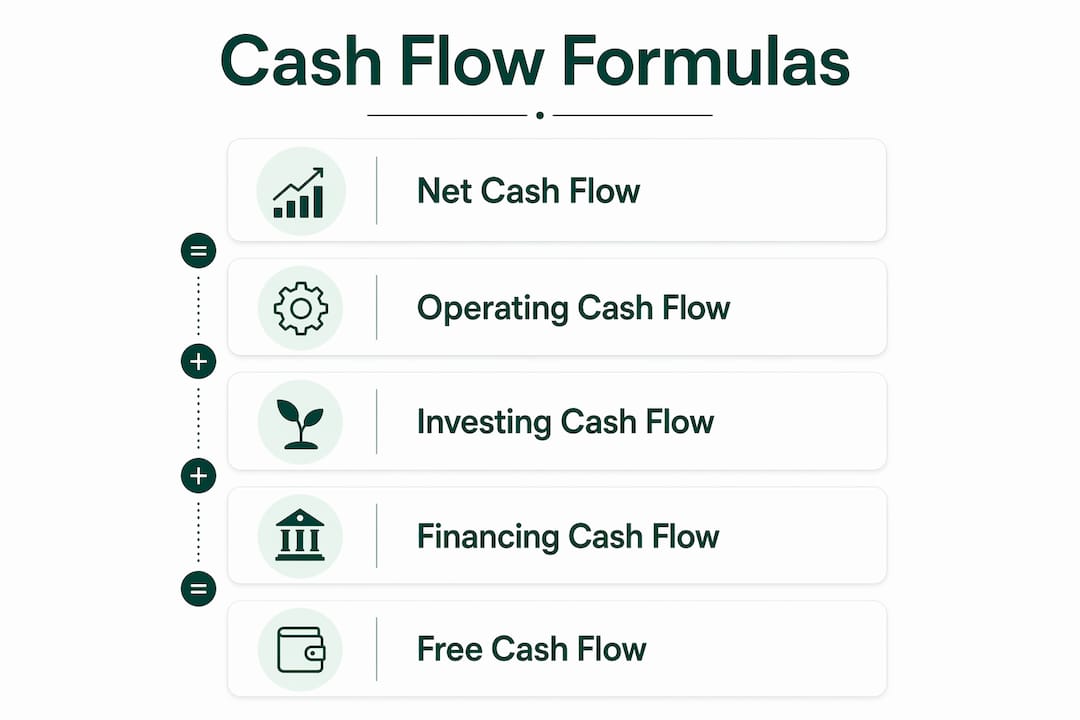
Cash flow formulas are mathematical expressions that quantify the inflows and outflows of cash in a business to assess liquidity and financial health. Every Canadian small and medium business owner needs these calculations to know whether the company can pay its bills, fund growth, and survive a slow quarter. The core formulas cover four areas: net cash flow, operating cash flow, investing and financing cash flow, and free cash flow. Together, they form the backbone of any serious cash flow analysis. Mastering them is not optional for financial managers. It is the difference between reacting to a crisis and preventing one.
What are the core cash flow formulas?
Net cash flow is the starting point for every liquidity calculation. The basic formula is straightforward: Total Cash Inflows minus Total Cash Outflows equals Net Cash Flow. A positive result means more cash entered the business than left. A negative result signals a potential liquidity problem before it becomes a crisis.
Cash inflows include customer payments, loan proceeds, asset sales, and investment income. Cash outflows cover supplier payments, payroll, rent, loan repayments, and taxes. For example, if your business receives $15,000 in customer payments and pays out $10,000 in bills, your net cash flow is $5,000. That $5,000 tells you the business generated real cash, not just accounting profit.

Net cash flow is not the same as net income. Net income follows accrual accounting, which records revenue when earned and expenses when incurred, regardless of when cash actually moves. Net cash flow tracks actual money in and out of your bank account. A business can show strong net income on paper while running dangerously low on cash.
Pro Tip: Run your net cash flow calculation weekly during high-growth periods. Revenue growth often consumes cash faster than profits can replenish it.
How to calculate operating cash flow using the indirect method
Operating cash flow (OCF) measures the cash your core business operations generate. The indirect method formula is: Net Income plus Non-Cash Expenses, adjusted for Changes in Working Capital, equals Operating Cash Flow. This is the standard approach used by accountants and financial managers worldwide because it starts from net income, which is already calculated, and works backward to cash.
The indirect method involves three adjustment categories:
- Add back non-cash expenses. Depreciation and amortization reduce net income on paper but do not take cash out of the business. A machine that depreciates by $8,000 this year did not cost you $8,000 in cash this year. Adding it back corrects the distortion.
- Adjust for working capital changes. If accounts receivable increased by $40,000, that means customers owe you more money but have not paid yet. That working capital increase reduces your actual cash flow by $40,000. Conversely, if accounts payable increased, you owe suppliers more but have not paid yet, which preserves cash.
- Account for inventory changes. Building inventory consumes cash. Reducing inventory releases it. A $20,000 inventory build reduces operating cash flow by $20,000, even if your income statement looks unchanged.
The result tells you whether your core business generates enough cash to sustain itself. A business with positive net income but negative operating cash flow is borrowing from the future. That pattern is unsustainable without external financing.
Pro Tip: Compare operating cash flow to net income every quarter. If operating cash flow consistently falls below net income, your working capital management needs attention.
How do investing and financing cash flows work?
Investing and financing cash flows complete the picture that operating cash flow alone cannot provide. Separating these three sections is not just good accounting practice. It reveals whether a business is growing, contracting, or restructuring its capital.
Cash flow from investing activities uses this formula: Cash Inflows from Asset Sales minus Cash Outflows for Asset Purchases equals Net Investing Cash Flow. Typical items include:
- Purchasing equipment, property, or vehicles (cash out)
- Selling old equipment or real estate (cash in)
- Buying or selling investments and securities (either direction)
- Spending on business acquisitions (cash out)
A consistently negative investing cash flow is not always bad. It often signals that a business is reinvesting in growth. A company buying new production equipment is spending cash now to generate more cash later.
Cash flow from financing activities follows this formula: Cash Inflows from Issuing Debt or Equity minus Cash Outflows from Debt Repayment and Dividends equals Net Financing Cash Flow. This section shows how the business funds itself and returns value to owners.
| Cash flow section | Typical inflows | Typical outflows |
|---|---|---|
| Operating | Customer payments, service fees | Payroll, rent, supplier payments |
| Investing | Asset sales, investment proceeds | Equipment purchases, acquisitions |
| Financing | Loans, equity issuance | Debt repayment, dividends |
The net change in cash for any period equals the sum of all three sections. For example: Operations at plus $115,000, Investing at minus $60,000, and Financing at plus $5,000 produces a net cash increase of $60,000. That number reconciles directly to the change in your bank balance.
What is free cash flow and why does it matter?
Free cash flow (FCF) is the cash left over after a business maintains and replaces its physical assets. The formula is direct: Operating Cash Flow minus Capital Expenditures equals Free Cash Flow. Capital expenditures (CapEx) are the purchases of long-term assets like machinery, vehicles, or building improvements.
Free cash flow answers a question that operating cash flow cannot: how much cash does the business actually have available for discretionary use? That discretionary cash can fund debt repayment, dividends, acquisitions, or a cash reserve. A business with strong operating cash flow but heavy CapEx requirements may have very little free cash flow left for anything else.
Consider a manufacturing business with $200,000 in operating cash flow and $150,000 in annual equipment purchases. Its free cash flow is $50,000. That $50,000 is the real measure of financial flexibility. Lenders, investors, and financial managers all use free cash flow to assess whether a business can service debt without selling assets or raising new capital.
Free cash flow also exposes businesses that fund growth by cutting maintenance spending. A company that defers equipment replacement will show rising free cash flow in the short term. That number looks good until the aging equipment fails and forces an emergency capital spend.
Pro Tip: Track free cash flow over rolling 12-month periods rather than single quarters. Seasonal CapEx cycles can distort a single quarter's reading significantly.
How to use cash flow formulas for forecasting
Cash flow forecasting turns historical formulas into forward-looking tools. The forecasting formula is: Beginning Cash plus Projected Inflows minus Projected Outflows equals Cash Flow Forecast. This calculation projects your ending cash balance for any future period, whether that is next week, next month, or next quarter.
Effective forecasting follows a clear process:
- Set your starting balance. Use your actual bank balance at the start of the forecast period. Do not use accounting balances that include uncollected receivables.
- Project inflows conservatively. Base projections on confirmed orders, historical collection rates, and signed contracts. Optimistic revenue assumptions are the most common forecasting error.
- List all known outflows. Include fixed costs like rent and payroll, variable costs tied to revenue, and any scheduled debt payments or tax installments.
- Adjust for working capital timing. Canadian businesses with net-30 or net-60 payment terms often collect cash weeks after recording revenue. Build that lag into your projections.
- Run scenario analysis. Create a base case, a downside case (revenue drops 20%), and an upside case. The downside case tells you how much cash buffer you need to survive a slow period.
The most common forecasting mistake is ignoring working capital changes. A business that wins a large contract may need to hire staff and buy materials weeks before receiving payment. That gap can create a cash shortage even during a period of strong revenue growth. Regular updates to your forecast, at minimum monthly, keep the projections grounded in current reality rather than stale assumptions.
Key Takeaways
Mastering cash flow formulas requires calculating net cash flow, operating cash flow, free cash flow, and forecasted cash positions as separate but connected measures of business liquidity.
| Point | Details |
|---|---|
| Net cash flow is the foundation | Subtract total outflows from total inflows to get your real liquidity position each period. |
| Operating cash flow uses the indirect method | Start with net income, add non-cash expenses, and adjust for working capital changes. |
| Free cash flow shows true flexibility | Subtract capital expenditures from operating cash flow to find discretionary cash available. |
| Forecasting requires conservative inputs | Use confirmed orders and actual collection rates, not optimistic revenue projections. |
| All three sections must be read together | Operating, investing, and financing cash flows together explain the full picture of cash movement. |
Why most business owners misread their own cash position
The most persistent mistake I see among small and medium business owners is treating net income as a proxy for cash. A profitable business can run out of cash. That is not a paradox. It is the direct result of accrual accounting, which records revenue before cash arrives and expenses before cash leaves. Cash flow statements bridge that gap by converting accrual results into cash-based reality. Ignoring that conversion is how businesses get blind sided by overdrafts in their best revenue months.
The second mistake is treating operating cash flow as the only number that matters. Operating cash flow tells you whether the core business generates cash. It does not tell you whether the business is overextended on debt, burning through reserves on equipment, or dependent on new financing to stay afloat. Financial sustainability requires reading all three sections together, every single period.
The businesses that manage cash well do not just run these calculations once a year at tax time. They build a monthly rhythm around their cash flow numbers. They know their operating cash flow trend, their free cash flow position, and their 90-day forecast before they make any significant spending decision. That discipline is not complicated. It just requires consistency.
— Monimate
Monimate and your cash flow numbers
Knowing the formulas is the first step. Applying them consistently, month after month, is where most business owners struggle. Monimate is built specifically for that gap.

Monimate's predictive cash flow tools alert you to upcoming liquidity shortages before they hit your bank account. The platform monitors your cash position in real time, applies forecasting logic to your actual transaction data, and sends early warnings when your projected balance drops below a threshold you set. For Canadian business owners who want to put the formulas in this article to work without building spreadsheets from scratch, the Monimate app gives you a live dashboard that does the calculation for you. Financial managers can also explore the Monimate financial glossary to reinforce the terminology behind every formula covered here.
FAQ
What is the simplest cash flow formula for small businesses?
The simplest formula is Total Cash Inflows minus Total Cash Outflows equals Net Cash Flow. A positive result means the business generated cash during the period.
How is operating cash flow different from net income?
Operating cash flow adjusts net income for non-cash expenses like depreciation and for working capital changes. Net income follows accrual accounting; operating cash flow reflects actual cash generated by operations.
What does free cash flow tell you that operating cash flow does not?
Free cash flow subtracts capital expenditures from operating cash flow to show how much cash remains after maintaining assets. It measures true financial flexibility, not just operational performance.
How often should a business update its cash flow forecast?
A business should update its cash flow forecast at minimum monthly, and weekly during periods of rapid growth or financial stress. Stale forecasts based on outdated assumptions create false confidence.
Why do investing and financing cash flows matter for liquidity management?
Investing and financing activities show how a business funds growth and manages debt. Focusing only on operating cash flow can mask unsustainable borrowing or asset depletion that threatens long-term liquidity.